Lakes & Mugal Gardens of Kashmir
World famour Lakes of Kashmir
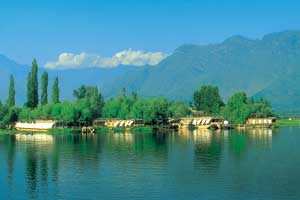 Srinagar's distinctive feature is the great body of water, the Dal Lake, which forms its focal point. The Dal has, within its area, two enormous sheet-like expanses of water-Lokut-dal and Bod-dal, the rest of its surface being broken up alternatively by man-made strips of land inhabited by whole colonies of people and vegetation.
Thus the lake is not a flat, unbroken mass of water, but a labyrinth of waterways, awash with a lifestyle not found elsewhere in the world.
The waters of the lakes are pleasantly cool from mid-May to mid-September. Shikaras can be hired from any of the steps called 'ghats' (jetties) leading to the lake. Some rides are fixed and their rates are posted at each ghat as well as opposite the Tourist Reception Centre. Shikaras are a refreshingly novel way of seeing Srinagar by day and at twilight, the gentle soothing motion of the boat, as it glides along the water, is unbelievably romantic.
Leading from the Dal is the smaller Nagin Lake. Here too, the waters are edged by trees of willow and poplar whose reflection is mirrored in the lake. 'Bathing boats' here, as well as on the Dal, hire out water-skis and motor launches.
Nagin lake lies to the east of the city at the foot of the Zabarwan Mountain. The Shankaracharya hill (Takht-i-Sulaiman) is to the south and Hari Parbat on its west. The lake is 6x3 km and is divided by causeways into four parts. Gagribal, Lakut-dal, Bod-dal and Nagin. Lokut-dal and Bod-dal each have an island in the centre, called Rup Lank or Char Chinari and Sona Lank, respectively.
Wular Lake: It is difficult to describe in mere words the beguiling beauty of Wular Lake. For one, its formidable size - this is one of Asia's largest fresh water lakes - for another, it changes character with every few miles.
Mugal Gardens in Kashmir - With terraced lawns, cascading fountains, paint-box-bright flowerbeds with the panorama of the Dal in front of them - the three Mughal Gardens of Chesmashahi, Nishat and Shalimar are the Mughal Emperors' concept of paradise and are today very popular places for picnics and excursions.
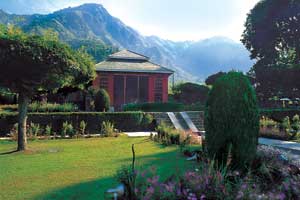 Shalimar Bagh: Built by Emperor Jehangir for his wife Nur Jehan, Shalimar, 15 kms from the Tourists Reception Centre, is a beautiful garden with sweeping vistas over gardens and lakes, and shallow terraces. The garden is 539 m by 182 m and has four terraces, rising one above the other. A canal lined with polished stones and supplied with water from Harwan runs through the middle of the garden. The fourth terrace, by far the best, was once reserved for royal ladies.
Nishat Bagh: Situated on the banks of the Dal Lake, with the Zabarwan Mountains as its backdrop, (11 km. from Tourists Reception Centre), this 'garden of bliss' commands a magnificent view of the lake and the snow capped Pir Panjal mountain range which stands far away to the west of the valley. Nishat was designed in 1633 AD by Asaf Khan, brother of Nur Jehan.
Chashma Shahi: Chashma Shahi has tastefully laid garden in terraces, which commands a magnificent view of the Dal Lake below and surrounding mountain ranges. The cool water of the spring is highly refreshing and digestive. The original garden was laid out by Shah Jehan in 1632 AD.
By the side of Chashma Shahi Garden are huts where some of the state government officials have their official residences to enjoy the luxurious stay while serving the Jammu & Kashmir State Government.
Pari Mahal: Once the royal observatory, Pari Mahal has a charmingly laid out garden and is a five-minute drive from Cheshmashahi. A Buddhist monastery at one time, it was converted into a school of astrology by Dara Shikoh, Mughal Emperor Shah Jehan's eldest son. Situated on the spur of a mountain overlooking the Dal, the ancient monument, with a well-laid spacious garden in front, is connected to Cheshmashahi by road. It is illuminated at night.
Harwan: On the hillside, south of the village of Harwan (19 kms from the Tourists Reception Center), remarkable remains of ancient ornamented tile pavements of the Buddhist period have come to light. The tiles depict the dresses of the people, such as loose trousers, Turkoman caps or close fitting turbans and large ear-rings which reveal Central Asian influence.