Festivals of Ladakh
In Ladakh, cultural traditions and ancestral customs are kept alive and vibrant through various festivals and celebrations, both religious and secular. Here, every occasion - marriage, birth, farming and harvesting, even the flowering of plants is celebrated with great fanfare, marked with feasting, dancing and singing of folk songs that form part of its rich culture. In summer, most villages hold archery festivals and thanksgiving events, while winter is the period in which most of the religious festivals and social and cultural events are held.
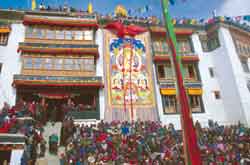
The festivals held in the monasteries are the ones with which Ladakh is famously associated. Almost all the major Buddhist monasteries hold annual festivals, mostly in winter. These take the form of dance-dramas performed by Lamas, attired in colourful robes and wearing fearsome masks. The most famous festival is that of Hemis which is held in early summer and is dedicated to Padmasambhava, founder of Tibetan Vjarayana Buddhism. Every 12th year, a huge Thangka of the saint is ritually exhibited during this festival. Other monasteries, which have summer festivals, are Lamayuru, Phyang, Takthok and Karsha in Zanskar. The monasteries of Spituk, Stok, Thiksey, Chemrey and Matho have their festivals in winter between November and March. Likir and Deskit (Nubra) hold their annual festivals coinciding with Leh Dosmochhe which is held in late February and is one of two New Year festivals, the other being Losar, which falls around the time of the winter solstice.
Monastic Festivals - The monastic festivals are annual events of the major monasteries which the local people eagerly look forward to attending, both for attaining religious merit and as a means of social entertainment. These are generally held to commemorate the establishment of a particular monastery, the birth anniversary of its patron saint or some major events in the history and evolution of Tibetan Buddhism. People turn out in the thousands to attend these festivals in their colourful best, making every event a carnival of colours.
The core event of the monastic festival is a highly choreographed ritual dance-drama known as ‘Chhams’, which is directed by the ‘Chham-spon’, the mystic dance master of the monastery. The dances are performed not only to dramatise the esoteric philosophy of the event for the benefit of the lay devotees, but also by way of ritual offerings to the tutelary deities of the monastery and the guardians of the faith. A select group of resident lamas of the monastery, dressed in brightly patterned brocade, robes, perform these dances in the courtyard of the monastery. They also wear masks representing various divinities, which are mostly found in the form of statues in the "Gon Khang", the room dedicated to the guardian divinities. Some of the dances also feature masks representing famous characters from historical episodes or Tibetan fables.
The more fearsome ones represent powerful divinities in their various manifestations, mostly representing the Dharmapalas or protectors of the faith. The dancers, holding ritual instruments in hands, step around the central flagpole in the monastic courtyard in solemn dance and mime, in tune with the music of the monastic orchestra. The ritual instruments and the hand gestures or mudras of the dancers symbolise different aspects of the dance-drama. In between the more sombre sequences, relief is provided by a group of comic performers who jump into the scene in the guise of skeletons and other characters, performing comic and acrobatic feats. These also wear masks representing various divinities and religious or historical characters.
As the ‘Chhams’ approaches its end on the second and last day of the festival, the climactic scene is enacted, in which the votive offering, a grotesque human figure made from dough, is ritually cut into pieces and scattered in the four cardinal directions. This figure symbolises the enemy of Buddhism as well as the embodiment of the three cardinal evils in the human soul viz. ignorance, jealousy and hatred. Accordingly, its destruction represents killing of the enemy of Buddhism and the purification of the human soul from the three evils. This ritual is known as ‘Dao Tulva’ and has many interpretations: cleansing of the soul from evils, dissolution of the human body after death into its elements, or a re-enactment of the assassination of the Tibetan apostate king Lang-dar-ma by a Buddhist monk in 842 AD. In fact, the long-sleeved dress and the huge hat worn by leader of the Black-Hat dancer, who executes this ritual in most festivals, represents the dress used by Lang-darma’s assassin to conceal his identity.
The ‘Rimpoche’ or head lama incarnate of the monastery conducts the rites and ceremonies of the festival. He sits on a high throne placed in the centre of the long veranda that runs along one side of the rectangular courtyard facing the huge, elevated gates of the monastery’s main prayer hall or Du-khang. This room actually serves as the green room for the artists during the festival.
The lamas of the monastery and the monk musicians in their full ceremonial attire, sit on carpet-covered cushions on either side of the throne in the veranda, according to their hierarchy.
The Rimpoche leads the lamas in the recitation of the mantras associated with the ‘Chhams’, thus creating the appropriate ambience for the dancers to enact the role of the deities whose guise they adopt. For the lay devotees, however, seeing the masked dancers serves to familiarise themselves with the kind of deities they are to encounter during the 49-day- ‘Bardo’ or transition period between death and rebirth in one of the six forms of existence, depending upon one’s karmic existence.
The monastic festivals also provide the local people an opportunity for socialising, trading and entertainment. On this occasion, makeshift markets spring up overnight near the monastery, to which people throng. During the summer festivals, the visiting people organise picnics, overnight excursions, and all-night signing and dancing parties.
For the more devoted villagers, however, the event is essentially a pilgrimage to the monastery and its various temples, for it is during this period only that they can see all the images and figures, which are otherwise kept veiled.
The 6-Year Calendar of Monastic Festivals - The monastic festivals of Ladakh are governed by the Tibetan calendar which is luni-solar. So the dates vary form year to year, requiring astrological calculations to determine each year’s calendar. Traditionally, at the end of the year, the astrologers prepare a new calendar of festivals so that it is available as the new year ushers in. But in the absence of long-term calendars, visitors face problems in planning trips to Ladakh to witness these events.
In order to address this problem this website has a 6-year calendar of festivals, for the period 2015 AD to 2020 AD, prepared by an astrologer, for the convenience of visitors
| Festival |
2015 |
2016 |
2017 |
2018 |
2019 |
2020 |
| Spituk Gustor1 |
January 18-19 |
January 7-8 |
January 25-26 |
January 3-4 |
January 3-4 |
January 22-23 |
| Stongde Gustor |
July 4-5 |
July 22-23 |
July 12-13 |
July 1-2 |
July 20-21 |
July 8-9 |
| DosmocheyLeh/Likir |
February 17-18 |
February 6-7 |
February 24-25 |
February 13-14 |
February 2-3 |
February 21-22 |
| Deskit Gustor |
October10-11 |
October 28-29 |
October 17-18 |
October 7-8 |
October 26-27 |
October 14-15 |
| Stok Guru Tseschu |
February 27-28 |
February 16-17 |
March 6-7 |
February 24-25 |
February 14-15 |
March 3-4 |
| Matho Nagrang |
March 4-5 |
February 21-22 |
March 11-12 |
March 1-2 |
February 18-19 |
March 8-9 |
| Saka Dawa |
June 2 |
May 20 |
June 9 |
May 29 |
June 17 |
June 5 |
| Hemis Tseschu |
June 26-27 |
July 14-15 |
July 3-4 |
June 23-24 |
July 11-12 |
June 30-July 1 |
| Yuru Kabgyad |
June 14-15 |
July 1-2 |
June 21-22 |
June 11-12 |
June 29-30 |
June 18-19 |
| Karsha Gustor |
July 14-15 |
July 31 Aug 1 |
July 21-22 |
July 11-12 |
July 30-31 |
July 18-19 |
| Phyang Tserup |
July 14-15 |
July 31-Aug 1 |
July 21-22 |
July 11-12 |
July 30-31 |
July 18-19 |
| Korzok gustor |
July 19-20 |
August 5-6 |
July 26-27 |
July 15-16 |
August 3-4 |
July 23-24 |
| Dakthok Tsechu |
July 26-27 |
August 13-14 |
August 2-3 |
July 22-23 |
August 10-11 |
July 29-30 |
| Sani Naro Nasjal |
July 30-31 |
August 17-18 |
August 6-7 |
July 26-27 |
August 14-15 |
August 2-3 |
| Shachukul Gustor |
July 4-5 |
July 21-22 |
July 11-12 |
June 30- July 1 |
July 19-20 |
July 7-8 |
| Thiksay Gustor |
October 30-31 |
November 17-18 |
November 6-7 |
October 27-28 |
November 15-16 |
November 3-4 |
| Chemday Angchok |
November 9-10 |
November 27-28 |
November 16-17 |
November 5-6 |
November 24-25 |
November 13-14 |
| Galdan Namchot |
December 5 |
December 23 |
December 12 |
December 2 |
December 21 |
December 10 |
| Losar |
December 12 |
December 30 |
December 19 |
December 8 |
December 27 |
December 15 |